“The Architecture of Trust: A Public Dialogue in Dnipro City
10
June 2026
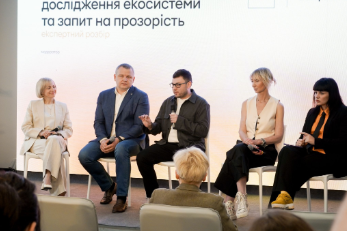
Charity in Ukraine is shifting from emotional impulse to systematic work, where trust, transparency, and responsible leadership are becoming key conditions for effective cooperation. This was discussed by participants of the open meeting, “The Architecture of Trust: Research, Experience, and the Demand for Transparency.”
The project’s goal is to transform the culture of charity in Ukraine from spontaneous "card collections" to systematic professional processes. For Dnipro, where volunteer work operates under maximum strain and high speed, it is critically important that all mechanisms work clearly and understandably.
“Charitable organizations build trust in their interaction with donors, and the bank provides a reliable and secure infrastructure for this process. We take on financial monitoring and control to guarantee transparent operations. If we recommend an organization, it is a signal to donors that it meets the necessary standards. This is why, when making a donation, people can be confident that their help is working toward a specific goal,” says Nataliia Savchuk, Deputy Chairman of the Management Board for Operational Issues at PrivatBank.
During the meeting, the results of a large-scale study by the Institute of Sociology of the National Academy of Sciences of Ukraine and the Center for Social Change and Behavioral Economics were presented, examining how charity standards are changing in Ukraine. The research shows that over 80% of Ukrainians consider charity an important part of life, but only every second person knows whom they can entrust their funds to. 51.2% of Ukrainians noted that they always or mostly deliberate about whom exactly to help.
Trust is one of the key factors influencing the decision to help, says Serhii Dembitskyi, Doctor of Sociological Sciences, Corresponding Member of the National Academy of Sciences of Ukraine, and Member of the Council of the Center for Social Change and Behavioral Economics. According to the research results, the reputation of those conducting the collection is crucial for 46.3% of Ukrainians. Furthermore, over 70% of respondents noted the necessity for openness and accountability of organizations and foundations.
“The defining factors for people’s decision—whether or not to join a collection—are reputation, accountability, and openness—the foundations of the ‘Architecture of Trust’ ideology. People give their money to those they know, who have experience and professional approaches to their work,” commented Olesia Zhulynska, Head of Public Relations at PrivatBank.
Charity in Ukraine has become an important element of societal resilience, speakers emphasize. However, responsibility, both to society and to partners, lies in clearly understanding one's capabilities and not losing focus, stresses Olha Rudnieva, CEO of Superhumans Center.
“Trust emerges when an organization has expertise, consistently works in its field, and delivers on what it promises. This is precisely what helps in finding partners, uniting people around common values, and achieving results that are trusted.”
For a region like Dnipropetrovsk Oblast, charity and volunteering have become part of the daily lives of hundreds of thousands of people, says Mykola Lukashuk, Chairman of the
Dnipropetrovsk Oblast Council: “Dnipropetrovsk Oblast is one of Ukraine's key frontline regions. When international partners and charitable foundations approach us, we primarily help gather and systematize the needs of communities so that aid reaches exactly where it is most needed. For every project, we ensure a clear understanding of how decisions were made, where resources were directed, and what results were achieved. The entire deputy corps of the regional council participates in this process. Decisions are approved by specialized commissions and then put to a vote at the session. This is the highest level of transparency. Such openness allows us to strengthen donor trust and attract new partners to support the region.”
Charity in Ukraine is transforming, demanding transparency, simple, and clear rules. “Many small charitable foundations and volunteer initiatives want to help but often face excessive bureaucracy that consumes time and motivation,” emphasized Anton Hulidin, Advisor to the Commissioner for Human Rights of the Verkhovna Rada of Ukraine, and Chief Operating Officer of the Ukrainian Institute for the Future. “That is why it is important to create simple and clear mechanisms for interaction.”
Experts noted that openness and honest communication work no less effectively than the best fundraising campaigns.
“I am convinced that today anything is possible when there is a common goal, trust, and strong partnerships. At the same time, it is important to clearly understand the difference between volunteering and professional charity, as each of these areas has its important role. Trust arises when organizations are visible, work systematically, transparently, and responsibly, and people understand exactly how their support helps achieve results,” says Maryna Perederii, Director of the Pomahaiem Charitable Foundation.
The discussion participants are convinced that transparent standards are a manifestation of responsible leadership and the foundation upon which trust in charity rests. They provide security to everyone who helps and reliable tools to those who make charity their profession. This is how a new culture of aid is being formed in Ukraine—based not only on empathy but also on responsibility, openness, and common rules.
The “Architecture of Trust” project is a partnership between the Center for Social Change and Behavioral Economics and PrivatBank.